
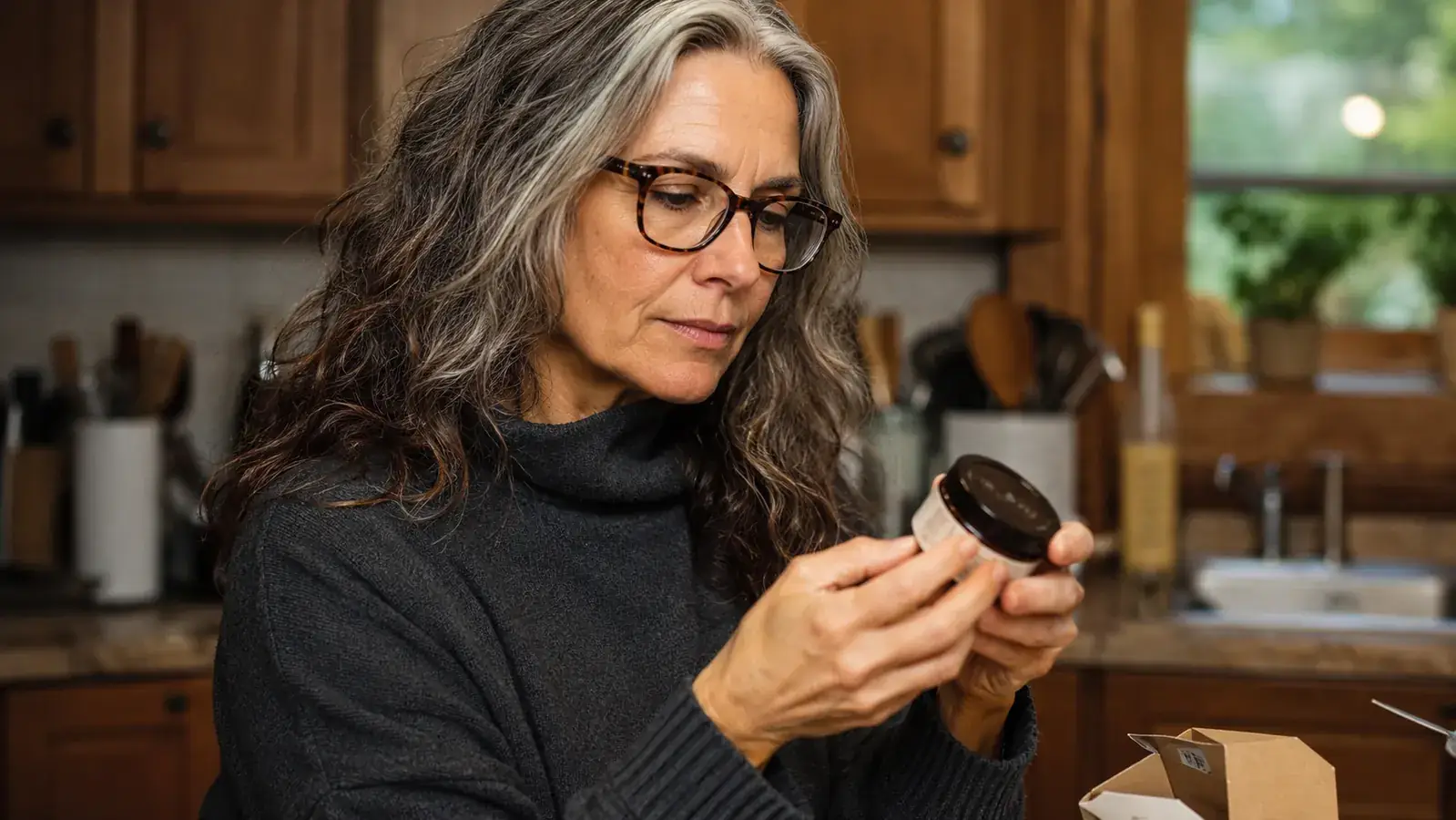
I want to start with something the Olay marketing team would prefer you not think about too hard. The front of the jar says Triple Collagen plus Retinol plus Peptides plus Niacinamide. It sounds like four separate heavy-hitting ingredients working together in some synchronized anti-aging system. But when you look at the actual formula, two of those four are doing the same job under different names, one of them cannot penetrate skin the way the label implies, and the retinol is real but almost certainly lower concentration than what a dermatologist would prescribe. None of that means the Olay Retinol Night Cream is a bad product. It means the label is written by a marketing department, and you deserve a clearer picture before you spend your money on it.
I am Diane Holloway. I spent about twenty years writing about the skincare industry before I retired, and I have kept testing products on my own face because old habits die hard and my opinions do not cost anyone anything anymore. I am 58. My skin is combination-dry with deep nasolabial folds, a scattering of brown spots on my left cheek from years of driving with the window down, and a thin, slightly crepe-like texture under my chin that no cream has come close to fixing in the way my ego hoped. I used the Olay Retinol Night Cream every single night for 90 days. I kept notes. What I found is genuinely mixed, which is exactly what you are going to get from me.
The Quick Verdict
A legitimate retinol night cream with an honest skin-feel, but the triple collagen claim is cosmetic marketing rather than a real collagen-building mechanism. Works best on texture, tone, and fine lines. Does not erase deep folds.
Amazon Check Today's Price →If you already know you want it, the current price on Amazon is solid for what you get.
Over 15,000 reviewers have tried this formula. See today's price and read what they said before you commit.
Amazon Check Today's Price on Amazon →What the Triple Collagen Claim Actually Means (and What It Doesn't)
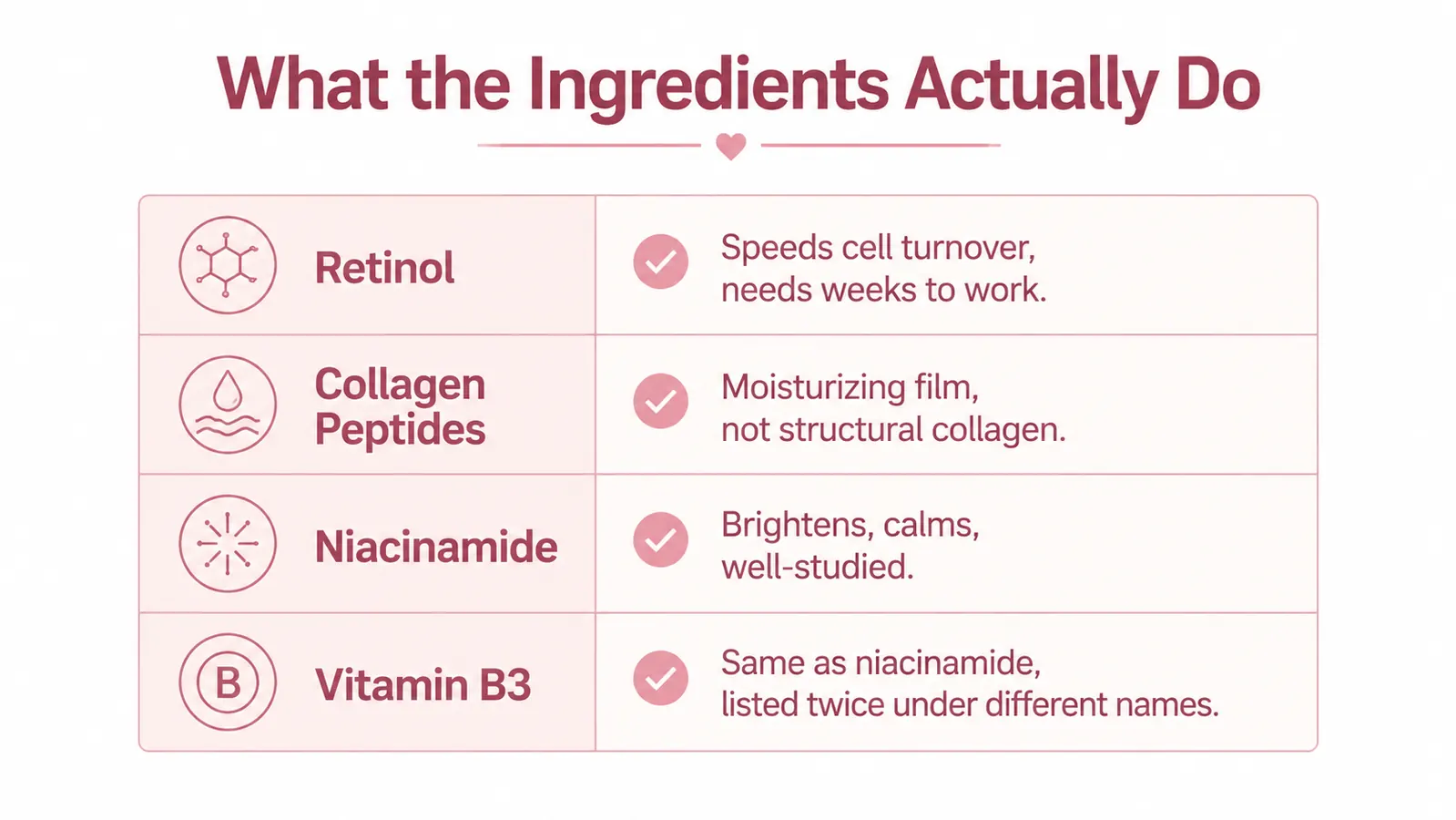
The triple collagen language on the jar refers to three collagen-related ingredients: hydrolyzed collagen, collagen amino acids, and collagen peptides. They sound distinct. In practice, hydrolyzed collagen and collagen amino acids are essentially the same thing at different molecular weights. Both are collagen proteins that have been broken down small enough to sit on the surface of skin and pull in moisture. They are good humectants. They are not building new collagen inside your dermis. No topical cream can do that, regardless of price or brand. The term collagen in skincare always refers to moisture-binding protein fragments that stay on top of the skin barrier. Any suggestion that they are restoring structural collagen in the tissue below belongs in the marketing copy, not in a science textbook.
Collagen peptides are a little different and worth separating out. Short-chain peptides can theoretically signal the skin to produce its own collagen, and there is real peer-reviewed science behind certain peptide sequences such as Matrixyl and Argireline. The problem is that the peptides in the Olay formula are not named on the label beyond the word peptide. I cannot tell you whether they are the signaling kind or simply another moisturizing film. That vagueness frustrates me more than the marketing claim itself. If you are going to put peptides on the front of the jar as a selling point, name the peptide and let the consumer look it up. The fact that Olay does not is telling.
None of this means the moisturizing effect is fake or that the cream is a waste of money. Hydrolyzed collagen is a solid, well-tolerated ingredient that plumps the appearance of skin by holding water at the surface. My skin looked and felt more cushioned within the first couple of weeks, particularly in the morning when dry mature skin tends to look its most parched. Just know that cushioned is not the same as structurally younger. If you are buying this cream because you believe it will rebuild collagen inside your skin, the formula will not do that. If you are buying it for a well-formulated retinol moisturizer that also happens to feel genuinely nourishing, you are much closer to what you are actually getting.
The Retinol Is Real, but the Concentration Question Matters
Olay does not disclose the retinol percentage on this product, which is a common practice among mass-market brands and one I wish the FDA would address. What I can tell you from looking at the ingredient panel is that retinol sits in the middle of the list. In cosmetic chemistry, ingredient order correlates roughly with concentration, with the highest-concentration ingredients appearing first and lower-concentration ones appearing later. A mid-list position typically indicates a concentration somewhere in the 0.025 to 0.1 percent range for retinol. Prescription retinoids start at 0.025 percent and go to 1 percent. Most over-the-counter retinols that deliver meaningful results run between 0.05 and 0.3 percent.
That is not necessarily a problem, and for many women over 50 it is actually the right choice. Lower retinol concentrations cause significantly less irritation, and mature skin tends to be thinner, drier, and more reactive than younger skin. I did experience mild flaking in weeks two and three, the normal purge that happens as retinol speeds up cell turnover, but nothing that required me to stop using the cream. By week five my skin had fully adjusted and the dryness was gone. Had I been using a 0.3 percent retinol, that adjustment period would have been considerably rougher and might have pushed a lot of women to quit before the benefits arrived. The moderate concentration is a feature for sensitive and dry mature skin, not a weakness. But be realistic: you will not see dramatic results in two weeks. The honest timeline is eight to twelve weeks minimum.
Niacinamide: The Ingredient Doing the Heaviest Lifting
The ingredient I wish Olay promoted on the front of the jar instead of triple collagen is niacinamide, also listed as vitamin B3 in the formula, which is the same molecule. Niacinamide has one of the strongest evidence bases of any ingredient in topical skincare. It reduces the transfer of melanin to skin cells, which is the mechanism behind dark spot lightening. It reinforces the skin barrier, which reduces both dryness and sensitivity over time. It has mild anti-inflammatory properties that calm reactive skin without requiring a prescription. And it is exceptionally well-tolerated, including on mature skin that cannot handle strong acids, high-concentration retinoids, or other potent actives.
On my left cheek, where I have had three or four stubborn brown spots from sun exposure, there was meaningful fading by the ninety-day mark. I was also using a separate vitamin C serum in the mornings, so I am not going to credit the Olay cream entirely. But I have used niacinamide formulas on their own in the past and seen real improvement in skin evenness over similar timeframes, so I believe this ingredient was doing genuine work here. The more I look at the full formula, the more I think niacinamide is what makes this cream worth the money. If Olay marketed it as a niacinamide plus retinol night cream, it would be a more accurate and more compelling sell than the collagen angle they chose.
The ingredient I wish Olay promoted instead of triple collagen is niacinamide. It has real science behind it, it works on dark spots and skin barrier strength, and it is present in a meaningful amount in this formula.
Texture, Scent, and the Experience of Actually Using It
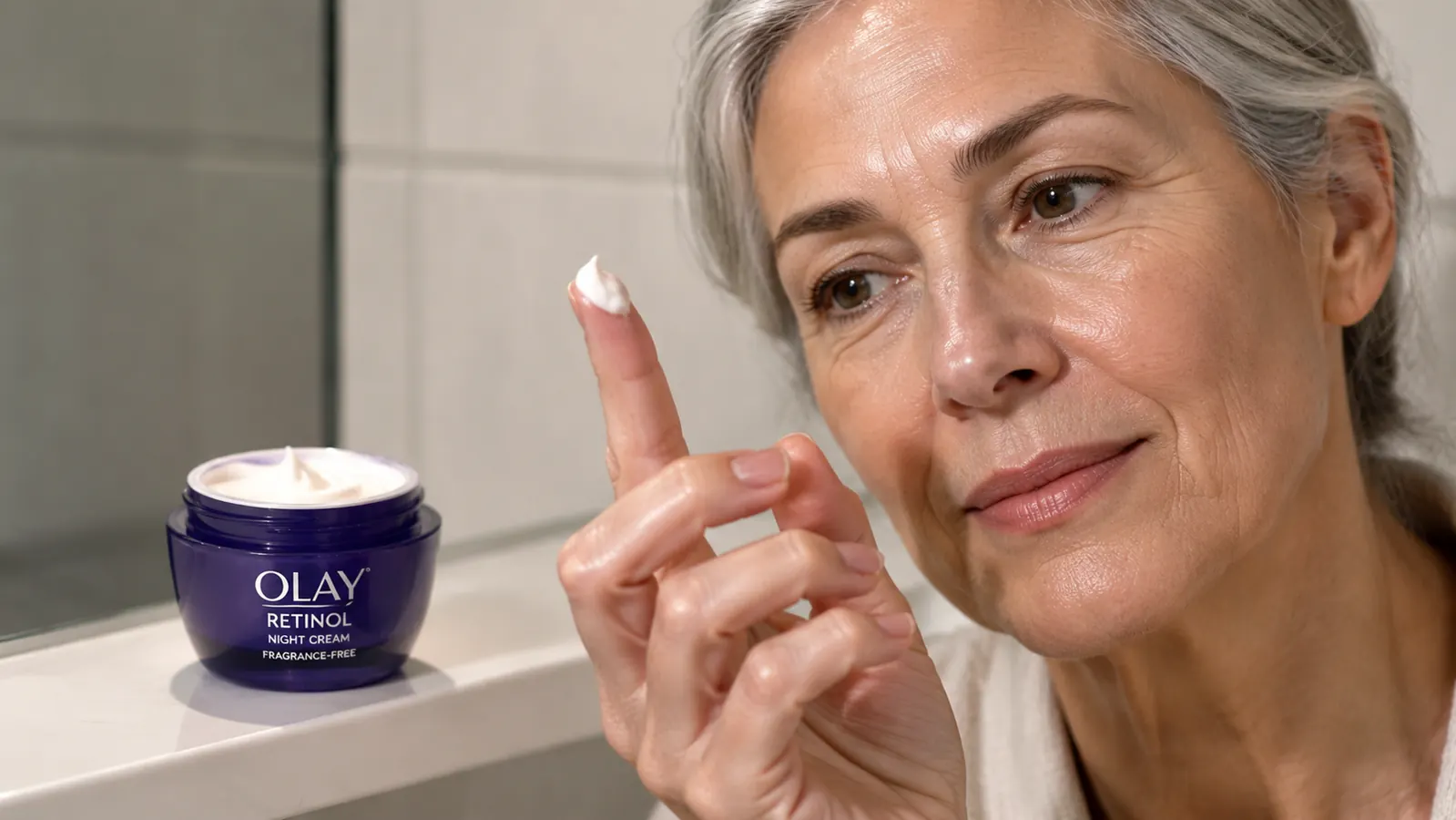
The cream is fragrance-free, which I want to say clearly because fragrance is one of the most common skin irritants in skincare products and a large portion of night creams still use it. Olay skipped it entirely here, and that matters for any woman whose skin reacts to perfumed products. The texture is thick enough to feel substantial when you apply it but not so heavy that it sits on top of your skin or takes forever to absorb. It sank into my skin within about two minutes and left a very slight tackiness that was completely gone by the time I was ready for sleep. I woke up each morning with skin that felt hydrated and plump rather than tight and stripped, which is the baseline I require from any night cream before I consider anything else it claims to do.
The jar packaging is the one design choice I genuinely dislike and want to flag before you buy. Every time you open a jar and dip your fingers in, you introduce both bacteria and air that degrade retinol faster than any other packaging format. Retinol is light-sensitive and air-sensitive. Olay uses an opaque jar, which handles the light problem, but the open-top design means every single use exposes the remaining product to oxygen. A pump or tube would be better for retinol stability. I kept my jar in a cool, dark drawer and used a small cosmetic spatula rather than my fingers for most of the 90 days, which helped. Most people will not bother with a spatula. If you can manage it, the habit is worth building because it extends how well the product performs toward the bottom of the jar.
What Changed Over 90 Days and What Honestly Did Not
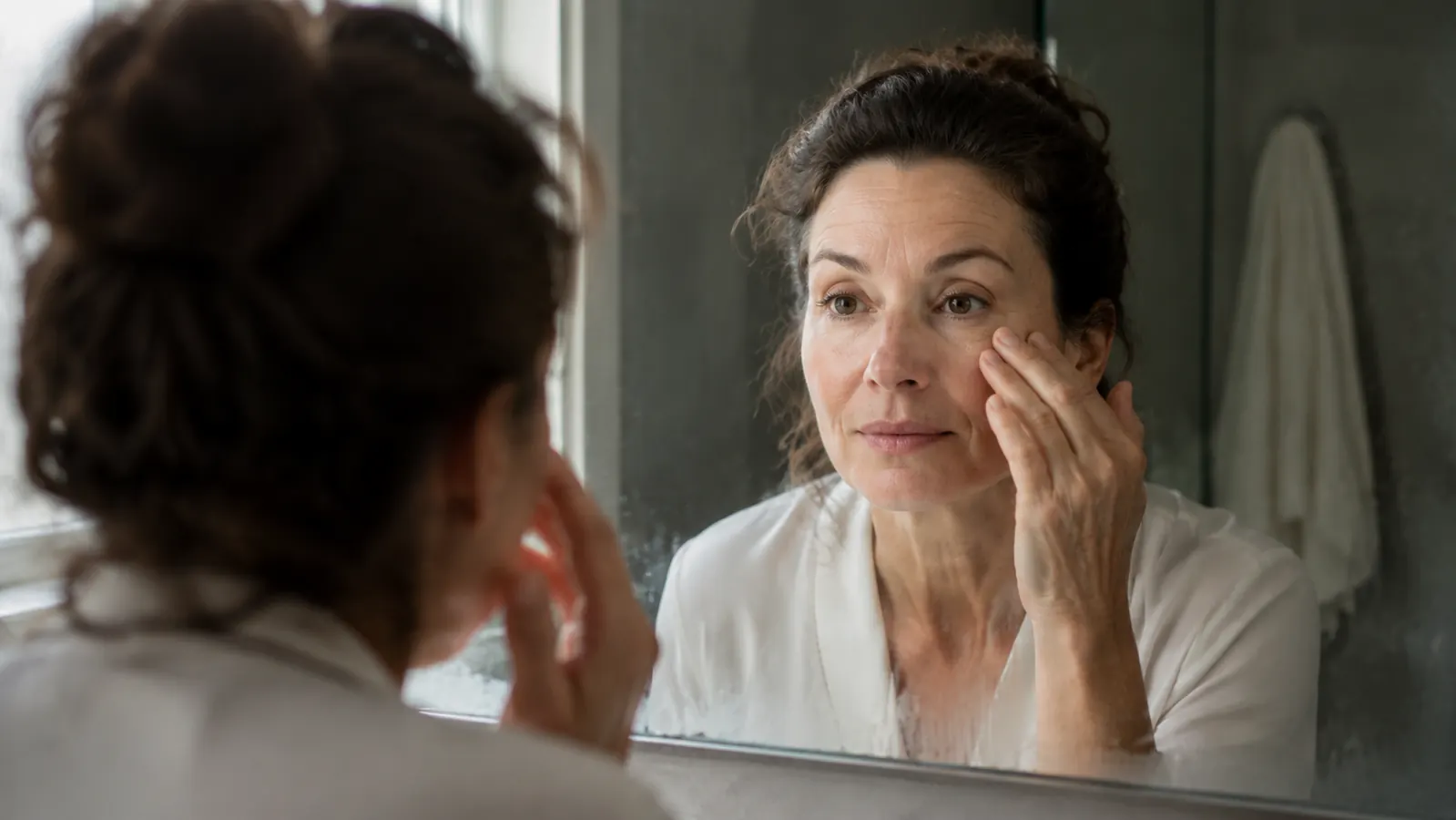
The texture of my right cheek, right temple, and forehead improved in a way I noticed without going looking for it. Rough, slightly flaky patches from winter dryness smoothed out by week six. My skin caught light differently in the morning, that particular glow that signals active cell turnover, and I take that as a reliable indicator that the retinol was doing its job. Fine lines at the corner of my right eye were measurably softer at ninety days. My husband commented on it without being asked, and I mention that because unprompted observations from someone who has seen your face every single day for many years are more meaningful than staring in a magnifying mirror.
The brown spots on my left cheek faded by roughly a third, which I attribute to the combined effect of niacinamide at night and vitamin C in the morning. The gray, tired quality my skin takes on in winter was much less pronounced by month three, replaced by a general evenness in color that I appreciated even though it is hard to quantify. Hydration levels were consistently better than they were when I was using a plain moisturizer at night. These are real, cumulative wins.
What did not change: my nasolabial folds. They are structural, carved in by decades of expression and gravity, and no over-the-counter cream addresses those meaningfully. I did not expect this one to, but I want to say it clearly because I have read reviews from women who are genuinely disappointed that their deep smile lines did not soften after a month of use. That is not a formula failure. That is the fundamental limit of what any topical product can do on deep folds without cosmetic procedures. If erasing nasolabial folds is your primary goal, nothing in this price tier or ingredient profile will get you there, and you should know that before you spend.
What I Liked
- Fragrance-free formula tolerates well on sensitive and dry mature skin
- Retinol concentration mild enough for beginners and thinner older skin types
- Niacinamide meaningfully addresses dark spots and uneven tone given enough time
- Genuinely nourishing texture that does not feel heavy or greasy by morning
- Fine line and texture improvement visible within six to eight weeks of consistent use
- Widely available, consistently priced, and easy to reorder
Where It Falls Short
- Triple collagen claim is cosmetic marketing, not structural collagen building in the skin
- Retinol percentage undisclosed, making it hard to compare or deliberately build concentration over time
- Jar packaging is the worst format for retinol stability
- Deep wrinkles and nasolabial folds do not respond meaningfully at this concentration
- Mild flaking is common in weeks two through four for first-time retinol users and should be expected
- Peptide type not disclosed on the label, leaving real questions about their mechanism
Who This Is For
The Olay Retinol Night Cream fits a specific and very real need. It is the right choice if you are new to retinol and want to start with a lower-irritation formula that will not overwhelm dry or sensitive mature skin. It is a good pick if fine lines, uneven tone, and general dullness are your primary concerns, because the retinol and niacinamide combination addresses all three over a consistent three-month timeline. It is also a reasonable maintenance cream if you have done more aggressive retinol work in the past and want a gentler formula you can use every night without worrying about irritation or the need to cycle off. The fragrance-free formula is particularly worthwhile if your skin is reactive or if you have had bad experiences with scented night creams in the past.
Who Should Skip It
If deep wrinkles are your primary target and you want a formula aggressive enough to address them, this is not it. You would be better served by a dedicated retinol serum at 0.1 percent or higher concentration paired with a separate moisturizer on top, which gives you control over both the active and the hydration separately. If you are already using a mid-strength retinol without irritation and are looking to increase the potency of your routine, the Olay formula will likely feel like a step down. And if the triple collagen language on the front of the jar is what made you reach for it, expecting plumped and structurally renewed skin, I want to be honest with you: those results do not exist in a jar, at this price or any price. What does exist in this jar is a well-formulated, fragrance-free night cream with real retinol and real niacinamide that will genuinely improve texture, tone, and fine lines over a committed ninety days. On those terms, it is a fair purchase.
Ready to try it? Your skin repairs itself every night whether you help it or not.
The Olay Retinol Night Cream has over 15,000 reviews and a fragrance-free formula that is easier on mature skin than most retinol products in its price range. See today's price and decide for yourself.
Amazon Check Today's Price on Amazon →