
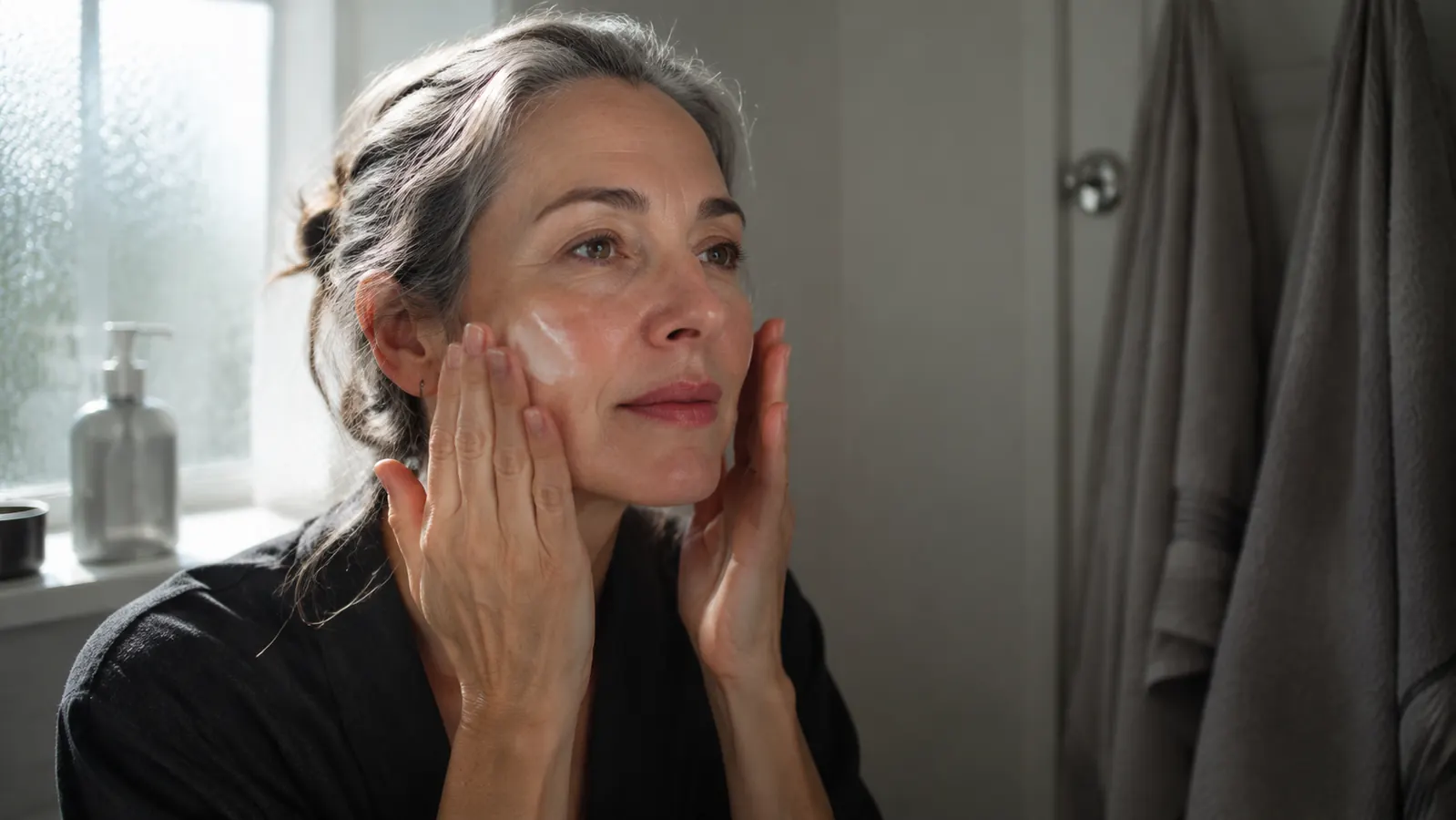
I want to tell you about the February morning I finally got serious about sunscreen. I was standing at my bathroom mirror, leaning in the way you do when the lighting is painfully honest, and I could trace almost every brown spot on my left cheek back to a specific decade of not wearing sun protection. My dermatologist had told me twice. My mother had told me for thirty years. I kept buying SPF products, using them inconsistently, then quietly shelving them when they balled up under my foundation or left me looking like I had rubbed chalk on my face. I am 58, I have dry, combination skin, and I was genuinely sick of that cycle. So I picked up the Eucerin Sun Age Defense SPF 50 Face Sunscreen, committed to wearing it every single morning through at least the end of June, and kept notes. This review is what I found after five months of daily use.
Full disclosure before we go further: I bought this sunscreen myself and nobody is paying me to write kindly about it. Eucerin has a 4.7-star average from more than 4,600 reviews on Amazon, which is unusually high for a face sunscreen, so my expectations were already raised going in. I wanted to know whether it would hold up on skin that tends toward dryness, shows visible sun damage on the cheeks and forehead, and is sensitive enough to flush when I try anything with fragrance or alcohol. Those are the stakes for this particular review.
The Quick Verdict
A genuinely daily-wearable SPF 50 for mature skin. The hyaluronic acid keeps dry skin comfortable, it sits cleanly under makeup, and after five months my derm noticed a measurable improvement in surface texture. The only real caveat is that the 2.5-oz bottle goes faster than you expect.
Amazon Check Today's Price →If you have been skipping SPF because every formula felt wrong on mature skin, this one is worth testing.
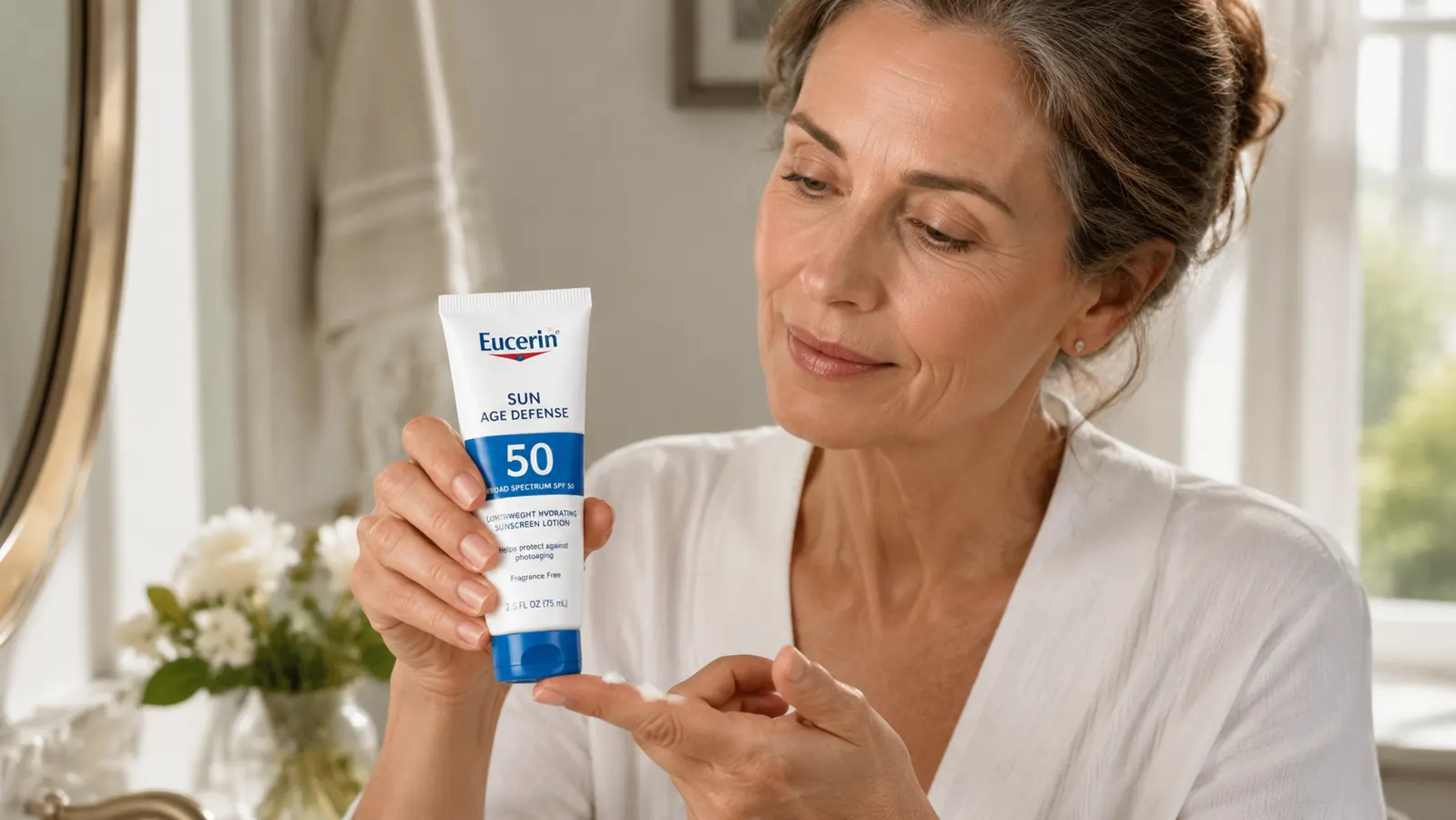
The Eucerin Sun Age Defense SPF 50 with hyaluronic acid is formulated specifically for aging skin. Check today's price and current availability on Amazon.
Amazon Check Today's Price on Amazon →How I've Used It: My Five-Month Testing Protocol
I applied this sunscreen every weekday and weekend morning from mid-February through mid-June, which covers the transition from low-UV winter light all the way into full summer sun in central Florida, where I live. I am 58 years old, fair-skinned, with a Fitzpatrick skin type II. My main concerns going in were: hyperpigmentation on both cheeks (decades of intermittent sun exposure), mild surface roughness around the forehead, and a tendency toward dry patches along the jaw in cold weather. I do not have active acne, though my skin will break out in small closed comedones if I use heavy occlusive formulas. That last point mattered a lot when I was deciding which sunscreen to commit to.
My morning routine during this period was consistent: gentle cleanser, a vitamin C serum (a separate product, not the Eucerin), two pumps of this sunscreen pressed into skin rather than rubbed, then foundation or a tinted moisturizer on top. I did not change my evening routine or introduce any new active ingredients, so any skin changes I noticed can be attributed to the sunscreen habit rather than something I added at night. I kept a phone note every two weeks logging texture, comfort level, any new spots, and how the product sat under makeup that day.
What the Formula Actually Contains (and Why It Matters for Older Skin)
The active sunscreen ingredients here are avobenzone (3%), homosalate (10%), octisalate (5%), and octocrylene (2.8%). That is a chemical filter combination, which means no white cast whatsoever, even on my fair skin. If you have had a mineral sunscreen leave you looking chalky or ashy, this formulation does not do that. Chemical filters work by absorbing UV radiation rather than reflecting it, so they integrate more seamlessly with the skin's surface.
What makes this formula interesting for mature skin specifically is the inclusion of hyaluronic acid in the inactive ingredients. Hyaluronic acid is a humectant, meaning it draws moisture toward the skin surface. For women over 50, whose skin produces substantially less natural oil and tends to feel tight by midday, a sunscreen that also delivers some hydration is a practical improvement over one that does not. The formula is also labeled hypoallergenic and non-comedogenic, and after five months I can tell you that both claims held up on my skin.
The ingredient I specifically looked for and did not find: fragrance. No fragrance, no alcohol denat, nothing that tends to cause flushing or stinging on sensitized skin. Eucerin's brand heritage is rooted in dermatology, and you can feel it in the formulation choices. They are not trying to make this smell appealing. They are trying to make it work.
Texture, Finish, and How It Sits Under Makeup
This is where most SPF products lose me. I have tried formulas that pilled catastrophically under powder, ones that turned my foundation orange by noon, and ones that left a slick film that made my skin look like I had been lightly lacquered. The Eucerin Sun Age Defense has a lotion consistency, slightly thicker than a light serum but thinner than a moisturizer. It spreads easily with two pumps for my whole face and neck, absorbs in about 90 seconds, and leaves a soft matte finish with no visible residue.
Under foundation, it performed better than any SPF I tested in the previous two years. I wear a medium-coverage liquid foundation and a translucent setting powder, and the Eucerin did not pill, shift the color, or break down by mid-afternoon. On the days when I skipped foundation entirely and wore only this plus a tinted SPF lip balm, my skin looked even-toned without looking coated. That combination of matte finish and no-pill performance took real consistency to confirm: I was not just lucky on one good skin day. Across five months of daily use, it held.
One important note on dryness: in February and March, when my skin was at its driest, two pumps of this alone felt like barely enough moisture for the whole day. I layered it over my vitamin C serum and that helped, but if you are using this in a cold or dry climate and your skin leans very dry, you may want to add a thin hydrating layer beneath it. By May and June, my skin had improved enough in surface hydration that the sunscreen alone felt comfortable.
By my three-month dermatologist appointment in May, she noted something I had not fully registered myself: the surface texture on my forehead had smoothed noticeably. She asked what I had changed. Sunscreen every day, I told her. Just that.
Five Months of Results: What Actually Changed on My Skin
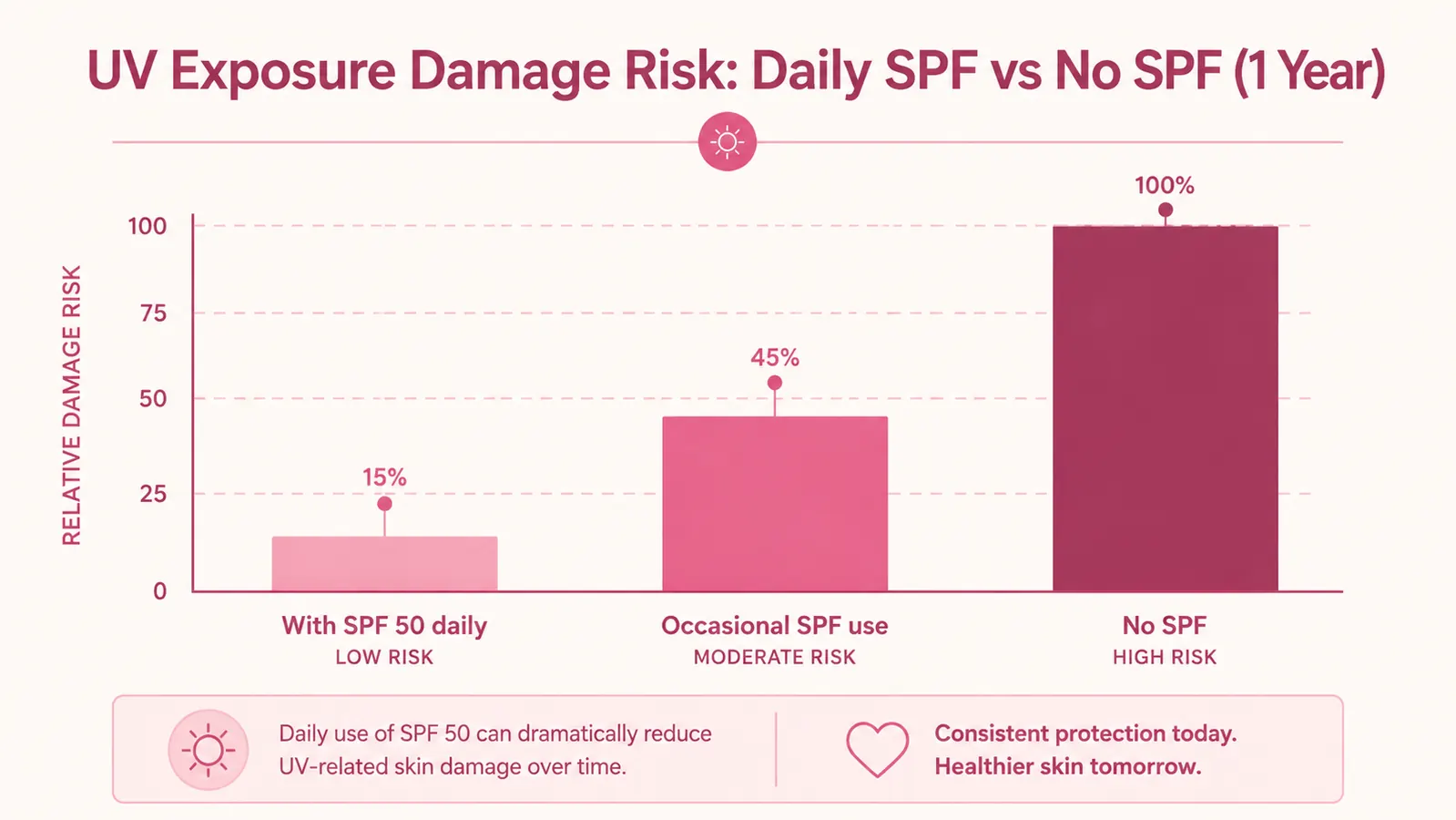
The most honest thing I can say about sunscreen results is that they are slow and often invisible until you look at old photos side by side. Sun protection works by halting further damage, which is inherently less dramatic than a serum that produces visible improvement in four weeks. That said, I did notice four concrete changes over this period.
First, the rough texture on my forehead softened. I had attributed it to winter dryness, but it did not come back in the same way in spring, even as the weather warmed. My dermatologist pointed this out at my May appointment before I had mentioned the sunscreen trial. She said the surface smoothing was consistent with reducing UV-induced inflammation, which had been causing subtle ongoing skin stress I was not consciously tracking.
Second, no new hyperpigmentation appeared on my cheeks during five months that included full Florida spring and early summer. That is not nothing. I typically develop at least one or two new sun spots per season. The existing spots did not fade noticeably, because this product contains no brightening agents, but the pattern did not worsen. If you want to fade existing spots, you will need a separate treatment, but stopping new ones from forming is the foundational step.
Third, my skin stayed more consistently comfortable throughout the day. I credited this partly to habit, partly to the hyaluronic acid keeping the moisture barrier supported. By month four I noticed I was reaching for my under-eye concealer slightly less often, which I believe was a side effect of my skin looking generally less tired. Correlation is not causation, but it was a welcome change.
Fourth, zero closed comedones, zero breakouts I could attribute to the formula. This matters because my skin had punished me for this with a previous SPF I tried. The non-comedogenic claim held across all five months.
What Did Not Work as Well as I Hoped
The bottle size is the first real frustration. The 2.5-fluid-ounce bottle sounds adequate until you are applying it to your full face and neck every single morning. With two pumps per application, I went through the bottle in roughly seven weeks. That means you are buying this sunscreen approximately every two months if you are committed to daily use, which adds up. I have started buying two at a time to keep a backup on hand.
The other limitation is that this formula does not do anything for existing sun damage. I want to be direct about this because I have seen other reviews imply the hyaluronic acid provides some active anti-aging benefit comparable to a retinol or a vitamin C. It does not. Hyaluronic acid hydrates. It does not exfoliate, fade pigment, or stimulate collagen. If you are buying this expecting visible brightening or line reduction from the sunscreen itself, you are going to be disappointed. Buy it because you need reliable SPF 50 protection in a formula mature skin can tolerate daily, and add your active treatments separately.
Finally, this is a chemical sunscreen, which a small subset of people find irritating regardless of the specific filters used. If you have had reactions to chemical SPF in the past, this will not necessarily be different for you. The formula is fragrance-free and hypoallergenic, but the chemical UV filters themselves are still present. People with known sensitivity to avobenzone or octocrylene should patch test before committing.
What I Liked
- No white cast at all, even on fair skin
- Hyaluronic acid adds real midday comfort on dry, mature skin
- Does not pill under liquid foundation or powder
- Fragrance-free and non-comedogenic, held true over five months
- Visibly halted new pigmentation during a full Florida spring and early summer
- Dermatologist noted measurable improvement in surface texture at the three-month mark
Where It Falls Short
- 2.5-oz bottle is gone in roughly seven weeks with consistent daily use
- Chemical filters may not suit people with known SPF filter sensitivities
- Does not fade existing dark spots or hyperpigmentation on its own
- Very dry skin in winter may need an additional hydrating layer underneath
- No brush or stick applicator option for touch-up reapplication during the day
How It Compares to What I Used Before
Before committing to the Eucerin, I rotated through three other daily-wear SPF products. One was a popular mineral sunscreen with zinc oxide that I kept reaching for when my skin felt reactive, but it left a visible cast that I could not overcome with foundation. The second was a drugstore SPF moisturizer-hybrid that sat nicely under makeup but broke me out in month two and I had to stop. The third was a premium Korean sunscreen that performed beautifully in texture but contained fragrance and would sometimes sting by midafternoon when I had been outdoors. None of those products made it past two months of daily wear. The Eucerin Sun Age Defense made it through five, without complaint, and that sustained consistency is worth more than any single feature on the label. If you want a more detailed head-to-head comparison between this formula and CeraVe AM Moisturizer SPF 50, I covered that analysis in a separate piece that looks at ingredient differences and price-per-use for mature skin.
Who This Is For
This sunscreen is well-suited for women over 50 with dry to combination skin who have tried and abandoned other SPF products because of texture complaints, white cast, or skin reactions. If your skin is sensitive enough to flush at fragrance but dry enough to need some hydration built into your routine, the Eucerin Sun Age Defense is specifically designed for that combination. It is also a practical choice for anyone who wears foundation daily and needs an SPF that will not undermine their makeup by midmorning. The formula is simple, the performance is consistent, and the price point is accessible enough that you can commit to buying it every six to seven weeks without it being a financial decision. For the specific problem of sun protection on mature, reactive skin, it handles the job better than most of the alternatives I found at a similar price.
Who Should Skip It
If you have a documented sensitivity to chemical UV filters, particularly avobenzone or octocrylene, this formula will not be right for you regardless of how much you like the rest of the ingredient list. Look instead at mineral SPF options with zinc oxide or titanium dioxide, and work with a tinted formula or color-correcting primer to manage any white cast. Additionally, if you are already using a moisturizer with SPF built in and you want to consolidate your morning steps, this is a standalone sunscreen rather than a moisturizer-SPF hybrid, so it adds a step rather than replacing one. And if you are expecting it to correct existing sun damage without a companion treatment, I want you to go in with clear expectations: this product protects going forward. For the fading work, pair it with a brightening serum or see a dermatologist about a targeted treatment. I also have a look at daily SPF habits and exactly why SPF 50 specifically makes such a difference in the long run, which covers the science in more accessible terms if you want that context.

Five months in, this is the first sunscreen I have not quit. If that speaks to you, it is worth a closer look.
The Eucerin Sun Age Defense SPF 50 with hyaluronic acid is formulated for aging skin, leaves no white cast, and sits cleanly under makeup. Check today's price on Amazon and see current availability.
Amazon Check Today's Price on Amazon →